
Video Library
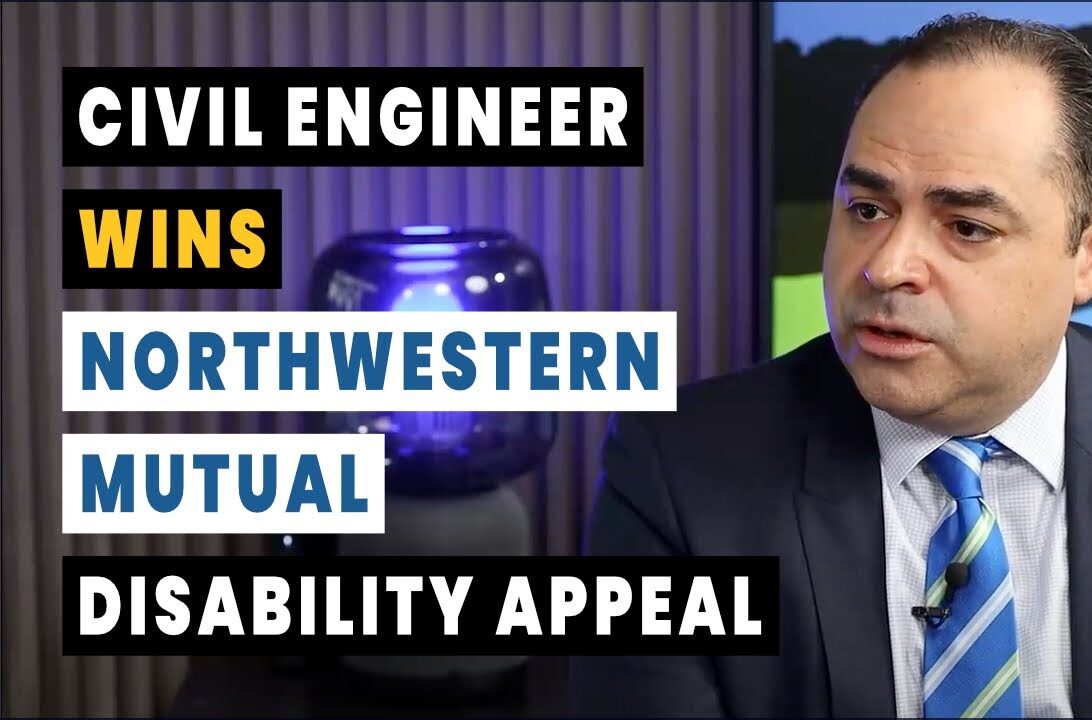
DarrasLaw wins a disability denial for a civil engineer with a high monthly benefit disability insurance policy from Northwestern Mutual.
The case involves a civil engineer who owned his own engineering company with a business partner and had purchased an individual disability insurance policy from Northwestern Mutual. The policy was specifically designed to insure him in his regular occupation and focused on the essential duties he was performing when he became disabled. Around 2022, after previously pushing through his symptoms, he began experiencing significant fatigue, cognitive fog, widespread pain, and other problems that increasingly interfered with his ability to perform his work. After seeing multiple physicians, a rheumatologist identified chronic fibromyalgia as well as a rare rheumatological degenerative condition supported by abnormal laboratory findings.
His symptoms became particularly problematic because of the precision and responsibility required in civil engineering. He worked on significant contracts involving cities, counties, states, and other governmental entities, and his job required him to produce accurate designs where mistakes could have serious consequences. As his fatigue, cognitive difficulties, and pain worsened, he struggled with clients and with preparing designs and eventually had to step away from his company. He then filed a disability claim with Northwestern Mutual.
Northwestern Mutual gathered his medical records and had them reviewed by a pain and rehabilitation physician. Despite the client’s treatment with multiple specialists, the reviewing doctor concluded there was insufficient objective evidence explaining his symptoms or supporting functional impairment. Northwestern denied the claim without ever paying benefits. The reviewing physician had never personally examined the client, spoken with him, or consulted his treating physicians before reaching that conclusion.
Attorney Caesar Gvidia developed an appeal focused on establishing the connection between the client’s diagnosed medical conditions, resulting symptoms, functional limitations, and specific occupational duties. Key components of the appeal included:
- Working closely with the client’s rheumatologist and other treating specialists to explain his symptoms, restrictions, and limitations in greater detail.
- Obtaining additional responses and medical evidence from his treating physicians addressing the objective testing and rheumatological findings Northwestern had discounted.
- Completing additional Functional Capacity Evaluation and neurocognitive testing to further document his functional problems.
- Demonstrating how fatigue, cognitive fog, widespread pain, and other symptoms interfered with the precision and sustained cognitive demands required of a civil engineer.
- Documenting the combined impact of chronic fibromyalgia, an autoimmune disorder, rheumatological abnormalities, and ankylosing spondylitis rather than relying solely on the existence of the diagnoses themselves.
A central issue in the appeal was the distinction between having a medical diagnosis and establishing disability. Northwestern did not necessarily dispute that the client had diagnosed medical conditions; instead, the insurer questioned whether those conditions produced restrictions and limitations severe enough to prevent him from performing his occupation. The appeal therefore needed to establish a clear connection between the medical conditions and the client’s inability to safely and reliably perform the essential duties of civil engineering.
The client’s treating physicians proved particularly important because they understood the full scope of his symptoms and strongly supported his disability. Gvidia communicated directly with the doctors, who provided additional information explaining why the client’s conditions prevented him from working. His physicians had also prescribed significant medications to help manage his pain and other symptoms and were cooperative in documenting how his medical problems affected his day-to-day functioning.
Northwestern Mutual ultimately overturned the denial and approved the client’s disability claim based on the additional medical evidence submitted during the appeal. Although an appeal apparently was not required under this particular individual policy, the attorneys chose to submit additional evidence and ask Northwestern to reconsider rather than immediately proceeding into potentially lengthy litigation. That strategy resulted in the client receiving benefits without having to wait through a lawsuit that could have taken years to resolve.
The case highlights why a diagnosis alone may not be sufficient to establish entitlement to disability benefits. Medical records should document not only the claimant’s conditions but also the symptoms, restrictions, limitations, and specific activities that aggravate those symptoms. Treating physicians can play a critical role by explaining how those limitations translate into an inability to perform particular occupational duties. For conditions such as fibromyalgia and autoimmune or rheumatological disorders, where an insurer may argue that objective evidence does not adequately establish impairment, connecting the medical evidence directly to functional and occupational limitations can be essential to a successful claim.